Malcolm Lanyon
Hide and SeekMalcolm Lanyon is an Edinburgh advocate whose celebrity, legal skill, and access to elite company make him a conspicuous figure in John Rebus’s investigation. His public persona initially appears almost too vivid to be a disguise: Lanyon is both a tabloid fixture and a formidable lawyer. As the case develops, Rebus links him to Hyde, and Lanyon’s death in police custody turns a figure of conspicuous privilege into one of the investigation’s most unsettling outcomes.
Identity and Public Image
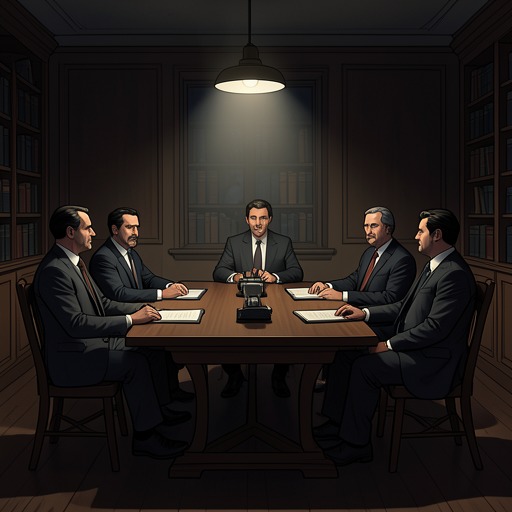
Lanyon first appears in company with Finlay Andrews at a meeting of the committee behind Superintendent Watson’s anti-drugs campaign. Rebus notices the contrast between Lanyon’s heavily built, muscular appearance and the exceptionally expensive blue suit threaded with silver. He looks younger than his silvered hair might suggest, and his manner is assured: the people at the table rise when he arrives, and he directs them to sit again with an elegant gesture.
His reputation precedes him. Andrews introduces him as an advocate, but the label is almost redundant to those present. Lanyon is known for a conspicuous lifestyle that provokes either envy or dislike and attracts the Sunday tabloids. Rebus regards him as a personification of what the legal profession is most often resented for, yet also recognizes that Lanyon is an extraordinarily capable lawyer. The distinction matters: his public image is not merely decoration concealing incompetence. His legal authority gives substance to his influence.
Lanyon’s appearance with a woman called Saiko adds to the impression of a life staged for public attention. She is beside him at the committee meeting and later opens his door when Rebus arrives at his house. Rebus recognizes her, or suspects she is pretending to recognize him. In both scenes, Lanyon’s surroundings and companions reinforce the sense that he moves through a social world unlike the one Rebus inhabits.
The Campaign and the Invitation
Lanyon recognizes Watson and praises the anti-drugs campaign. The project combines public awareness with discreetly funded information and has fifty thousand pounds pledged by a group of local businesspeople. His approval gives Watson visible recognition from a prominent figure, while also placing Lanyon among the influential people surrounding the campaign. He asks Andrews whether he has forgotten an engagement for the following evening, then invites the committee members to a casual gathering at his home on Heriot Row, one of the New Town’s most exclusive streets.
Rebus is unsure whether the invitation is serious, but the prospect attracts him. When he attends, he wears a borrowed jacket that fits imperfectly. Lanyon’s house is imposing, and the guests include recognizable faces, business leaders, and people known by reputation. Yet Lanyon is not initially present, though guests say they spoke to him earlier in the evening. That absence leaves Rebus to move through the house without a clear encounter with his host.
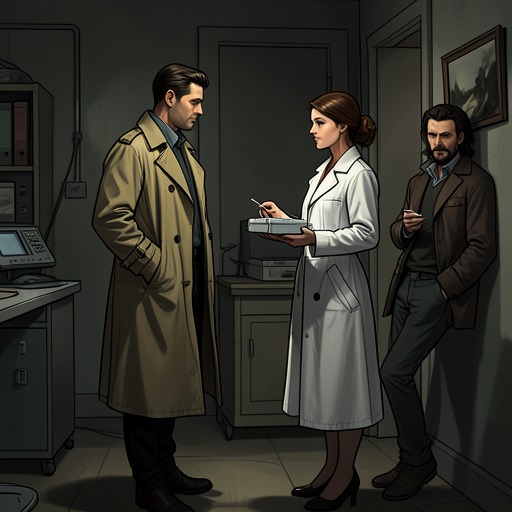
Later, after Tommy McCall has become noisy and drunk, Rebus makes a second, solitary circuit. He goes upstairs to the library, where he wants to examine a working desk. The room is dim, and a lamp now illuminates papers on the desktop; Rebus remembers that it was not lit on his first visit. Lanyon is waiting against the far wall. The change in the room and the host’s sudden appearance turn an apparently casual party into a setting for a private encounter. Lanyon notices Rebus’s borrowed jacket and says Saiko told him he had arrived.
James Carew and the Investigation
In the library, Lanyon tells Rebus that he is James Carew’s executor and is trying to determine who will benefit from Carew’s will. When Rebus asks whether they were close, Lanyon says he knew Carew fairly well. Rebus then asks whether Lanyon knew Carew was homosexual. Lanyon does not immediately respond, but then confirms that he knew and says that he does not believe homosexuality is a crime. His answer identifies a personal dimension of his acquaintance with the dead man while resisting the implication that Carew’s sexuality itself should be treated as wrongdoing.
The exchange gives Lanyon a defined connection to Carew beyond the formal task of settling the will: he knew about a private fact that Rebus considers relevant enough to test in conversation. The pause before his answer is part of the scene’s tension, but it does not establish what else Lanyon knew about Carew or the circumstances of his death. The evidence supports the connection and Lanyon’s response, not a fuller account of their friendship.
Hyde and the Exposure of a Hidden Identity
By the investigation’s later stages, Rebus refers to Lanyon as Lanyon-alias-Hyde, linking the celebrated advocate to the name at the center of a hidden establishment. The contrast between the two names sharpens the character’s public-private division: the tabloid-famous lawyer and the figure associated with Hyde occupy the same identity, even as Rebus’s investigation approaches that connection from the outside. The evidence does not make every detail of the establishment’s operation Lanyon’s personal statement; what it establishes for his character is the identification Rebus uses and the danger surrounding the world it names.
Lanyon’s status also affects the atmosphere of that world. The account of Hyde’s describes a place frequented by people with influence and suggests that their participation would make prosecution difficult. Rebus later says he is going to see Lanyon-alias-Hyde, using the identification openly. Lanyon is therefore not just a fashionable presence encountered at a committee table: he becomes a point where elite respectability and the concealed network under investigation meet.
Death in Custody and Narrative Significance
After his arrest, Lanyon is held for questioning at Great London Road Police Station. Rebus remains officially excluded from the investigation, and Detective Sergeant Dick and Detective Constable Cooper have been assigned to question him. Rebus nevertheless goes to the station because he knows the kinds of answers and evasions Lanyon might use and does not want a technicality to help him escape accountability. Brian Holmes falls into step with Rebus as he goes to look in on the prisoner.
The inquiry ends abruptly when a sergeant opens Lanyon’s cell and finds him dead, with thin wire connected to his neck. The discovery is a death in custody, not a courtroom reckoning: Lanyon dies before Rebus can remain close to the questioning or see the case proceed through the legal process. The passage presents the discovery without resolving, in the evidence here, who placed the wire or how Lanyon acquired it.
Lanyon’s arc binds the novel’s social surfaces to its criminal investigation. At first, his wealth, celebrity, and professional competence make him seem securely established in public life; the party offers a literal entry into that world, while the library supplies the concealed meeting place within it. His identification with Hyde complicates the image without erasing the lawyer’s public standing. His death in custody then denies the investigation a straightforward public accounting, leaving his influence and the hidden identity attached to him as part of the case’s unresolved cost.